Scotland pioneered wind power. Now we must deliver its next chapter.
Almost 140 years ago, Scotland pioneered wind power.
In 1887, James Blyth developed the world’s first wind turbine capable of generating electricity in Marykirk. His most successful prototype produced enough power in a moderate breeze to light ten 25-volt bulbs.
Today, more than 10GW of operational onshore wind provides the backbone of Scotland’s energy system, generating home-grown electricity for millions of homes and businesses.
It is an extraordinary transformation. But Scotland’s next chapter in wind power matters just as much as its first which will be fundamental to delivering the UK’s future energy system.
As consumers continue to feel the impact of volatile global energy prices, the technology first demonstrated in Aberdeenshire has never mattered more.
Global investment in clean energy continues to outstrip investment in fossil fuels. The direction of travel is clear, but the prize is bigger than decarbonisation alone.
Our future prosperity will depend on abundant, affordable and secure energy. For the UK, onshore wind is one of the quickest and most cost-effective ways of delivering it.
By producing more power here at home, we can reduce our exposure to volatile international gas markets and strengthen our energy security. And we should be clear: without the nation’s existing fleet of onshore and offshore wind farms, our exposure to recent international energy shocks would have been greater.
As an established sector in Scotland, onshore wind is deeply embedded in our economy. It supports more than 16,000 jobs, sustains contracts for local suppliers and provides tens of millions of pounds each year for communities hosting projects.
That local investment matters. Across Scotland, community benefit funding has helped create lasting local assets and opportunities, from community facilities and services to energy efficiency and skills schemes.
Since taking up my role as Chief Executive of Scottish Renewables, I have been struck by the scale of what Scotland’s onshore wind sector already delivers and the opportunity still ahead.
My early conversations with members and government have also reinforced that what comes next cannot simply be ambition for ambition’s sake. We need a clearer view on the role of all technologies in our future energy system, with greater alignment between the decisions that will enable that future to be delivered.
For onshore wind, that means both growing and renewing the sector.
Some of our earliest wind farms are approaching the end of their operational lives, bringing repowering firmly into focus. At the same time, around 19GW of projects have planning permission or applications submitted, with further capacity at earlier stages of development.
Maximising Scotland’s onshore wind opportunity means supporting new development while increasing capacity through repowering, ensuring generation and local value are not unnecessarily lost as projects reach the end of their operational lives.
That makes the decisions being taken now about our energy system particularly important. The Strategic Spatial Energy Plan must provide a clear trajectory beyond 2030 that supports Scotland’s onshore wind opportunity and gives confidence in both new development and our existing fleet.
The economic prize is significant. Analysis shows that more than 70% of spending across an onshore wind project’s lifecycle can be retained domestically, supporting local jobs, suppliers and communities.
But having a clear destination is not enough. We also need to be able to get projects there.
Progress on planning and consenting will only translate into new generation if projects can secure timely grid connections, viable routes to market and fairer transmission charges. Removing one barrier only to encounter another will not deliver the pace or scale of investment we need.
This is where the Scottish and UK governments must work together. They hold different levers, but planning, grid, charging and market policy ultimately need to enable the same outcome: viable projects moving from development into operation.
Years of policy ambition, investment and innovation have brought Scotland to a position of real strength. Our task now is to turn that strength into the next generation of projects, investment and lasting value.
Almost 140 years after James Blyth first turned Scotland’s wind into electricity, we have an opportunity to do what Scotland has always done best: innovate, build and lead.
-
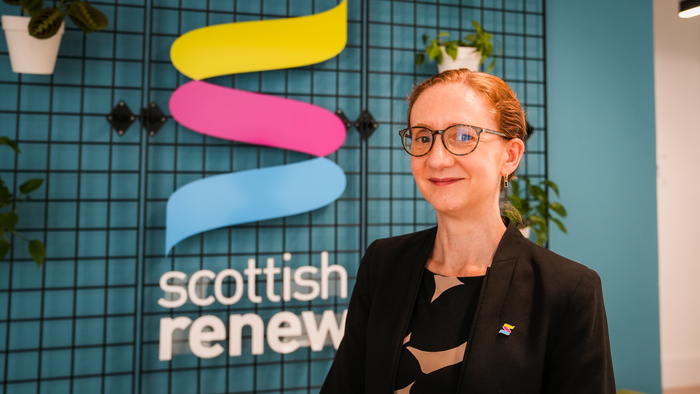
By Angela Hepworth, Chief Executive of Scottish Renewables.
This article was first publised in reNEWS on August 28.